As a Finance major student, I spend a lot of times looking for ways to improve my financial skills. I have always been fascinated in the world of finance and how it functions. I was very excited when I first learned about finance as it is such a fantastic subject and I also found out a speech that share a lot of my thoughts. The speech helps me to understand the necessity of becoming more informed about finance and it also shows me how to use the Internet to find reliable information. I learned a lot of important information upon writing this essay, so I want to share all my thoughts with you about this great speech. Hopefully, my essay would help you to see the author’s strategies in the speech and how he was able to deliver one of the best speeches at the time.
https://www.sec.gov/news/speech/speecharchive/1999/spch269.htm
In 1998, the U.S. Securities and Exchange Commission (SEC) – a government agency that informs and protects investors from illegal transactions and frauds – launched an ongoing, educational campaign called Facts on Saving and Investing Campaign in order to encourage individuals to learn about wise saving and investing. Arthur Levitt, who was the longest serving Chairman of the SEC, dedicated his life to educating and protecting American investors. In 1999, one year after the establishment of the campaign and partnerships with multiple media, Levitt spoke at the Media Studies Center in New York to media school students and important SEC commission members to demonstrate a successful campaign and his gratefulness towards the media’s help. In the excerpt from his speech at the Media Center in New York, Arthur Levitt uses a serious yet objective tone, along with solid statistics and feasible solutions, in order to encourage people to join and spread his campaign to help people understand the necessity of becoming financially literate to control one’s personal financial life.
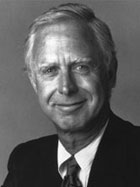
Chairman of the SEC
Arthur Levitt
At the beginning of his speech, Arthur Levitt introduces the crisis of financially illiterate Americans in order to illustrate the severity of the problem that millions of American lives paycheck to paycheck. He begins his speech stating that we are in the “midst of a financial literacy crisis” and using the repetitive phrase “many people.” This repetitive phrase demonstrates the lack of knowledge and information about financial stability among the majority of Americans. Levitt uses bold and repetitive phrases to develop a fear of missing out among the audience; therefore, he encourages the audience to learn and research more. After establishing the problem, Levitt justifies the financial literacy crisis with detailed evidence. He states that “sixty-five million American households” fail to reach their major life goals simply because they have not developed a comprehensive financial plan. This enormous number demonstrates the need for all Americans to, at least, create a basic plan for their major goals in life. Levitt uses real-life circumstances in order to connect the audience to the crisis; thus, he urges the audience to become more informed. Levitt also mentions one of the main reasons for this problem is the abundant amount of information on the internet. He states that with a pace of ten websites a day, one could spend “two and a half years” to explore all the finance topics. The long period of time illustrates the glut of information in the Information Era as one would struggle to differentiate between scams and false articles from helpful websites. The use of a hyperbole targets the struggle of finding useful and correct information; therefore, it shows the author’s understanding on the struggle that everyone face in order to strengthen his authority and build up more credibility. Ultimately, Levitt uses strong data and logical arguments to clearly provide the context for the financial literacy crisis and establish the cause of this problem and the struggle in the fight against being financially illiterate; furthermore, Levitt explains how the internet could become a viable solution if it is used properly.

In addition, Levitt describes how to use media to resolve the financial problem and provide a strong result from using the internet in order to assert the effectiveness of the media in helping people control their financial personal life. He begins his speech by confirming the power of the media. He claims that smoking in middle school saw a significant drop of “twenty percent in one year” after an aggressive media campaign that promotes anti-smoking. The real-life situation illustrates the capability of the media influence to this generation. The strong result also enhances the credibility of Levitt to his audience. He gives useful tips to his initial audience that he wants the stories and lessons about financial stability to “jump” to the front page, and the media needs to “spotlight” these stories for the readers in their newsfeed. These words indicate the urgency for these stories to be seen by everyone, and then he establishes a duty and responsibility for his primary audience at the Media Center. He also put out a simplified plan to help with making a well-informed investment decision which contains three main steps. First, one need to find out a suitable “investment goals,” commitment time, and risk tolerance. He clearly explains the solutions step by step. His plan becomes more effective and trustworthy to the audience with the use of the logical method in his solution. Ultimately, Levitt analyzes his solution and gives realistic examples in order to prove his solutions are feasible and functional; additionally, Levitt finally describes his successful campaign in order to recruit more people to join the campaign.
At the end of his speech, Levitt demonstrates extraordinary results of the campaign in order to stimulate an action in the audience to join the campaign. After explaining to his audience how the media, in proper use, could become such a powerful tool, Levitt introduces his campaign and urges people to promote it. He uses detailed information to explain the achievement of his campaign with the media’s help. Some of his successful programs in the campaign such as “Ballpark Estimate” which helps calculate the amount of money needed for their goals or retirement or a “Mutual Fund Cost Calculator” to see how the mutual fund could add up over time. Detailed results from his campaign demonstrate the successfulness of his campaign and set these websites apart from the scam and fraud websites. The strong result also asserts the belief of the audience for the success of this campaign. Remarkable words such as “vital,” “defining,” and “democratization” are used towards the end of the speech to demonstrate that the world is quickly changing, and important moment requires strong actions from everyone. These intellectual words make the audience feel like they are in the moment that will soon become historic and make them to adopt changes and new things. In those very last sentences of the speech, Levitt uses lots of call-to-action phrases and words. He describes this moment as a unique opportunity which could be lost out due to ignorance, and he suggests the headline to be “Get the facts. It’s your money. It’s your future.” Levitt creates an astounding headline and takes the first step into the change and lets the media decide the future of our country, thus, urging them to join with him in the campaign and follow his suggestions. Ultimately, Levitt uses detailed information and influential information in order to describe the results of the campaign and give a final push to the audience to join his investing campaign.
In his speech at the Media Studies Center, Levitt uses a momentous yet informative tone, along with strong evidence and practical solutions, in order to encourage people to join his campaign and help decrease poverty due to a lack of knowledge. The author uses well-researched data and realistic situations along with clear analysis to deliver a successful speech and achieve his purpose of recruiting more people to join the campaign. Levitt wants everyone to overcome fear of money-related problems and become well-informed in order to make good decisions for one’s personal finance condition. The illiterate crisis and the problem and the consequence has frightened the audience, but there is something in his speech that comforts and relieves the audience. This speech creates complete reform of how the news categorizing their news-feed as personal finance and economy usually become its own category. Levitt’s ability to convey complex information in layman’s terms is one of the reasons he becomes one of the most respected speakers about finance. This speech would help the audience to see the necessary of learning more about one’s personal finance and to also help influence other to stay informed.
Levitt, Arthur. “Speech by SEC Chairman: Financial Literacy and Role of the Media.” U.S. Securities and Exchange Mission, 26 Apr. 1999, www.sec.gov/news/speech/speecharchive/1999/spch269.htm. Accessed 07 Feb. 2019.

 Your Financial Handbook